Study Abroad in 2027: Countries, Costs & Visa Guide
Studying abroad remains one of the most valuable investments a student can make in their future — but the path to getting there looks different than it did even two years ago. Governments across the major study destinations have introduced new intake caps, revised post-study work rules, and tightened financial documentation requirements, while a fresh set of destinations has emerged offering strong education at a lower cost.
None of this makes studying abroad harder to justify. It makes it more strategic. Students who start early, understand exactly what’s changed in their target country, and build a genuinely strong application will still find outstanding opportunities in 2027 — they just need sharper, more current information to get there.
This guide covers what you actually need to know: what’s changed for 2027, why it matters, and how to plan around it.
Why Study Abroad in 2027?
A degree earned abroad is no longer read as just an academic credential — it signals adaptability, independence, and the ability to operate in unfamiliar environments, all of which employers actively look for in a global job market.
Universities are also leaning further into industry partnerships than before, building internships, live research projects, and placement pipelines directly into their programs. Students get access to labs, faculty, and teaching methods that often aren’t available at home, and graduate having built a genuinely international professional network almost as a byproduct of where they studied.
For most students, the return isn’t just the degree on paper — it’s the combination of stronger employability, a wider career map, and personal growth that’s hard to replicate by studying at home.
Why 2027 Is Different from Previous Years
The rules of the game have moved. Here’s what’s actually changed heading into 2027 — not the general trend, but the specifics.
Stricter Student Visa Policies
Changes in Post-Study Work Opportunities
Rising Cost of Education
Between tuition increases, higher visa fees, and cost-of-living pressure in major student cities, the total cost of a foreign degree has climbed. Beyond tuition, students should budget realistically for accommodation, food, transport, health insurance, visa costs, flights, and an emergency buffer — and build that full picture before applying, not after receiving an offer.
Increased Competition
Intake caps mean fewer available seats in some of the most popular destinations. Canada, for instance, has cut new study permits to roughly 155,000 for 2026 — down sharply from prior years — which means stronger applications are now competing for fewer spots. Admissions committees are responding by evaluating candidates more holistically: a compelling Statement of Purpose, relevant internship or research experience, and a clear career narrative now carry real weight alongside grades.
More Affordable Study Destinations Are Emerging
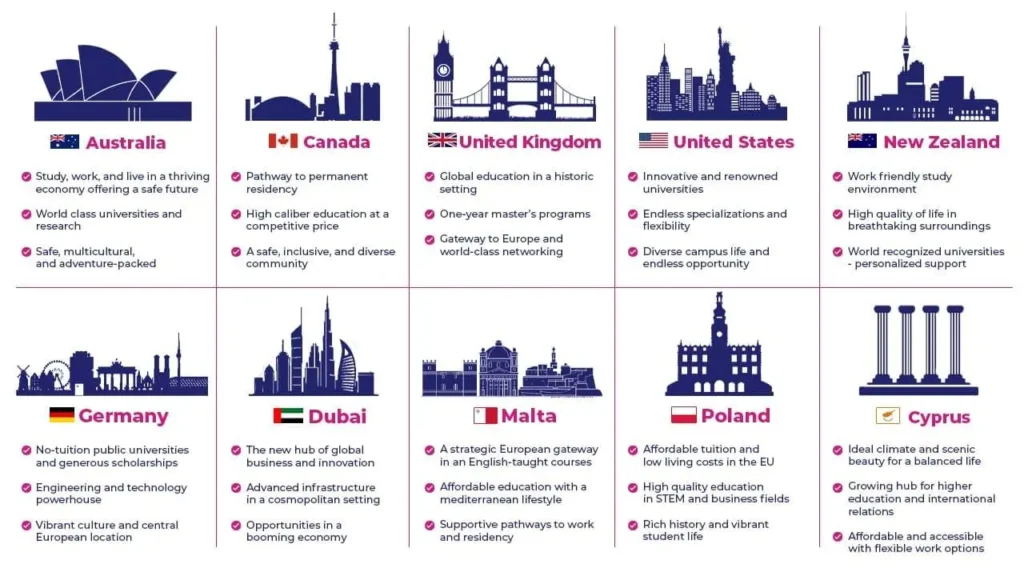
While the UK, Canada, Australia, and the US remain the most recognized names, a second tier of destinations is actively competing for international students. Germany continues to offer low or no tuition at many public universities alongside a growing number of English-taught master’s programs. Ireland offers an English-speaking, EU-adjacent option with a comparatively smoother visa process. France has set a goal of reaching half a million international students by 2027 and is expanding its English-medium offerings to get there. The UAE is also emerging as a lower-cost hub with strong industry links. For cost-conscious students, these markets are worth serious comparison rather than an afterthought.
Benefits of Studying Abroad
A Globally Recognized Qualification
A degree from a well-regarded international university travels with you — it’s recognized by employers across borders, giving graduates more flexibility in choosing where and in which industry to build a career.
Access to Stronger Academic Resources
Leading universities abroad tend to invest heavily in research infrastructure and industry-linked teaching. In practice, that means modern labs, project-based coursework, and access to faculty working on active research — resources that can be limited at home.
A More Direct Path Into the Workforce
Many universities build career services directly into the student experience: structured internship placements, employer recruitment fairs, and dedicated career counseling. These aren’t just nice extras — they meaningfully shorten the gap between graduation and a first job.
Real Independence
Managing your own finances, housing, and daily logistics in a new country builds decision-making and problem-solving skills faster than almost anything else in early adulthood. Most students who’ve done it will say this, not the classroom, was where they grew the most.
A Genuinely International Network
Classmates, professors, and alumni from dozens of countries become part of your professional circle — and international networks like this tend to open doors in ways that are hard to replicate through a local degree alone.
Cultural and Language Fluency
Daily life in a new country — not just coursework — builds cross-cultural communication skills that are increasingly valued in global teams. Students in non-English-medium countries often pick up real conversational fluency in a second language along the way.
A Longer-Term Career Edge
Beyond the first job, international experience tends to compound: it shows up favorably when candidates are being considered for leadership roles, cross-border assignments, or roles at multinational employers further into a career — not just at graduation.
Best Countries to Study Abroad in 2027
| Country | Popular For |
|---|---|
| UK | Business, Finance, Engineering |
| Canada | Business, IT, Engineering |
| Australia | Healthcare, IT, Engineering |
| USA | STEM, Business, Research |
| Germany | Engineering, STEM |
| Ireland | IT, Business, Pharma |
| France | Business, Fashion, Engineering |
| UAE | Business, Finance, Technology |
How to Plan Your Study Abroad Journey for 2027
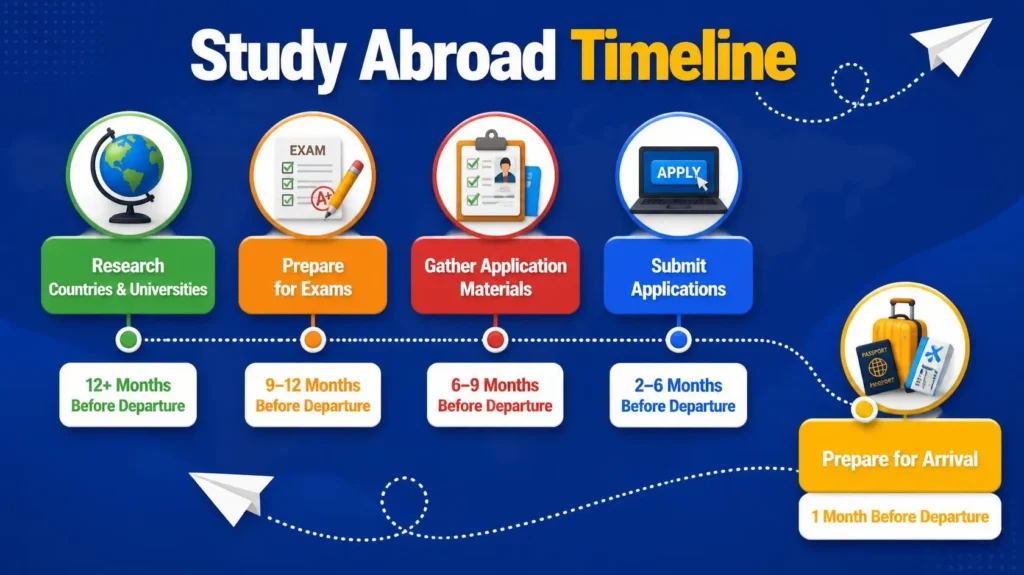
Step 1: Choose your course
Step 2: Shortlist countries
Step 3: Research universities
Step 4: Check eligibility
Step 5: Take IELTS/PTE/TOEFL/GRE/GMAT if required
Step 6: Prepare documents
Step 7: Apply to universities
Step 8: Compare offers
Step 9: Arrange finances
Step 10: Apply for your student visa
Step 11: Arrange accommodation
Step 12: Prepare for departure
Documents You May Need to Study Abroad
- Passport
- Academic transcripts
- Degree/provisional certificate
- English-language test score
- CV/resume
- Statement of Purpose
- Letters of Recommendation
- Work experience documents, if applicable
- Financial documents
- Scholarship documents
- University offer/admission letter
- Health/insurance documents where required
- Visa documents
Frequently Asked Questions
There is no single best country for every student. The right destination depends on your course, budget, career goals, preferred language, and post-study work plans. The UK, USA, Canada and Australia remain major study destinations, while Germany, Ireland, France and the UAE can be attractive alternatives depending on your priorities. Compare tuition fees, living costs, university quality, visa requirements, scholarships and post-study work opportunities before choosing a country.
The total cost depends heavily on the country, university, course and city. Your budget should include tuition fees, accommodation, food, transportation, health insurance, visa fees, flights and an emergency fund. Students should also check the minimum financial evidence required by their chosen country's student visa rules. For example, Australia requires students to demonstrate sufficient financial capacity, while other destinations have their own financial requirements. Always check the latest official requirements before applying.
Germany is often considered one of the more affordable options because many public universities generally do not charge tuition fees for most programmes, although exceptions apply and students still need to budget for living expenses and other costs.
France and some other European destinations can also offer comparatively affordable options, while Ireland, the UAE and selected universities in other countries may provide competitive programmes and scholarships. Affordability should be assessed using the total cost of study, not tuition alone.
Yes, studying abroad can still be a valuable investment in 2027, particularly for students who choose a programme and destination that match their academic and career goals.
However, students should make the decision based on more than university rankings. Consider the total cost, scholarship availability, quality of education, employability, visa rules, post-study work opportunities and long-term career plans.
The international education landscape has become more competitive and policy changes are increasingly important. For example, Canada has introduced study-permit limits, while the UK is changing the duration of its Graduate visa for applications from January 2027.
The key is not simply choosing to study abroad, but choosing the right country, course and university for your goals and budget.
There is no universally best option because post-study work rules depend on the country, qualification and immigration policy in force when you graduate.
For example, the UK's Graduate visa currently provides 18 months for applications made from 1 January 2027, while PhD graduates can receive three years.
Ireland also has a Third Level Graduate Programme that can allow eligible graduates to remain after their studies to seek employment. The duration depends on the qualification and applicable rules.
Students should therefore compare post-study work rules as part of their country-selection process and verify the regulations that apply to their specific course and graduation year.